
Escape! a novel by Stephen Fishbach: Who Do You Think You Are?
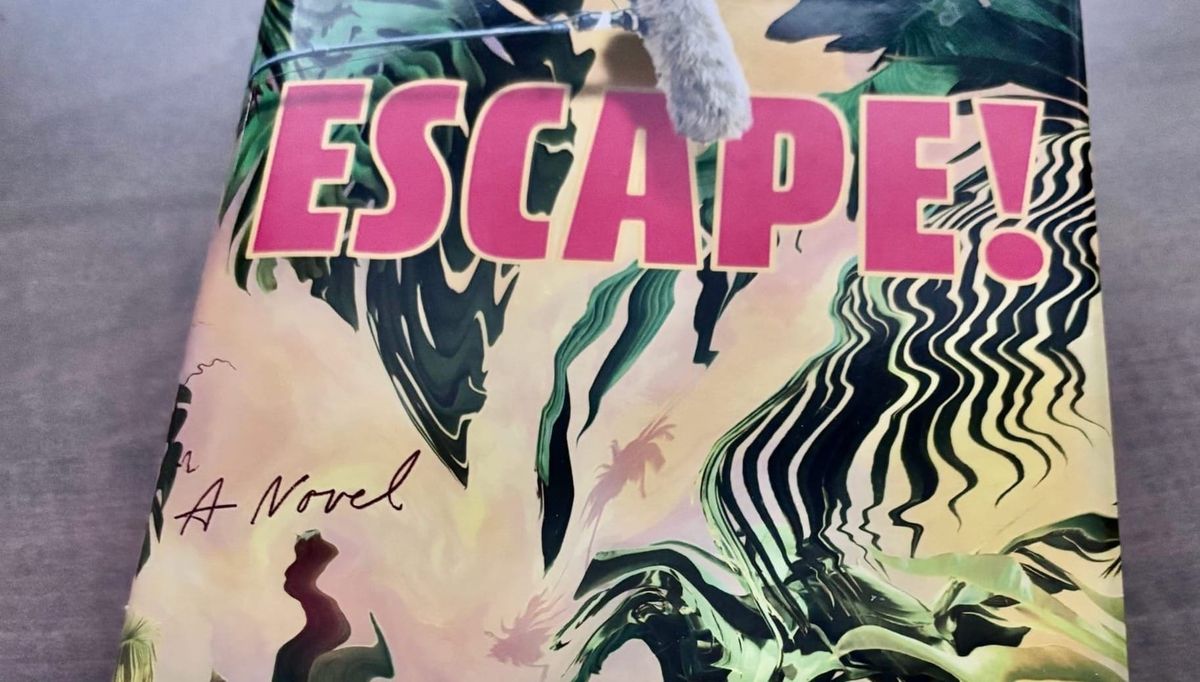
P.S. (Pre-script, in this case): this essay contains some spoilers.
Mr. Stephen Fishbach is a cutie patootie two-time player of our favorite game, Survivor. He was in the final two on Tocantins (losing to "golden boy" J.T.). He came back for Second Chances in Cambodia, where he finished 9th. He also cohosts the RHAP podcast Survivor Know it Alls with fellow cutie patootie two-time Survivor player, Rob (the Rob of RHAP) Cesternino from The Amazon and All-Stars. Now he is officially a novelist.
First, let me say, this is not exactly a review. At least not a typical one. Because I will not be writing a detailed summary of the story and plot. Go here or here or here. And because I don't fancy myself a book critic. So, this is me, standing in front of you (metaphorically), sharing some thoughts and feelings about a book I thoroughly enjoyed. Who doesn't love some old fashioned thoughts and feelings?
EVERYONE LOVES THOUGHTS AND FEELINGS!
And, because I'm me, there will be a lot of thoughts and feelings related to psychology and existential philosophy. Buckle up, nerds.
But--but!--the general gist of the book is this: There's a new reality television show (it's called Escape!) being made where the premise is Survivor-like. Fishbach's idea for a reality show/game is actually pretty cool. Players are living on a remote island in the South Pacific ("Some enchanted evening, I will find my true love..." Sorry, couldn't help myself) and dealing with the elements while figuring out food and shelter, much like Survivor. There are challenges and rewards, but people don't want to stay try and stay longer, they want to leave, to actually get off the island. Eventually, anyway. On another island, there's a treasure box full of prize money to be found and opened, but first they've got to build a raft to get there. No one is voted off, but people are expected to quit, and some of them might (and actually do) build a raft in secret. The treasure has more money added to it the longer the game goes (kind of like Squid Games). And players can earn keys and raft supplies via challenges. The big question is, do they work together to get to build the raft and get to the other island, thereby having to split the prize money, or do they work against each other to get a bigger piece of the pot? A million is what's possible.
So, basically a psychology experiment within a psychology experiment. Like Survivor, part of the appeal of this idea is that we are watching a varied group of people – each a certain archetype (the nerd, the mom, the alpha male, the spoiled rich kid, etc.) taken out of their normal lives and trying to live and work together to "survive" in the sometimes harsh elements with little food and no comforts, only the clothes on their back and one provided helpful item per player (a machete, etc.). But there's also the element of game-playing: what will people do to win? Lies, betrayal, social maneuvering. All of that. Can the players trust each other enough to make plans together, build the rafts, wait for the money pot to grow larger? And there's a third part to the contrivance, because it's also a produced television show. So, there's the question of reality vs. manipulated reality. The producers want certain things to happen and so they do their best to make them happen. Like providing the pig to "hunt" or stealing supplies that the players think they've lost or encouraging certain relationships and behaviors through heavy suggestion and psychological manipulation. And there's even another level! There's the producing of the producers. So, levels of manipulation as well as questions of what is authentic? What is choice? What is our actual authentic desire and how does it play out in what we do? Are we making a choice because it's what we truly want or because we were influenced by others even if we have come to believe it is what we want? Are we making a choice because it is a demonstration of who we are or are we choosing based on fear, avoidance, etc.?
Every decision a character in this book makes has to be studied within the context of their history, their motivations, and finally, what is encouraged by those creating the show. Does the character/player wear the clothes they have on because they are the clothes they like and picked out or because it's what they are comfortable in or are they presenting a certain archetype? I mean, we can ask this of ourselves, too, in our everyday lives. Do I dress for myself? For who I really am? Or do I dress for what I think I should look like to impress others or to be perceived a certain way? What is true? What is authentic? And when people know a camera is capturing their every move, they might not behave in a way that is actually representative of who they are deep down, but who they think the audience wants. What will show up on the television show? What will create excitement or drama? What will make me look good or interesting or hot? And what might help me gain more followers on social media? Or get me cast on another show? What is reality, I ask you? On a reality show, is anything truly reality? In life, in our everyday existence, what are we doing because it's what we want and what are we doing because we think it's what will get us ahead (or loved, or desired, or secure). And the other big question is, do we know the difference?
So, yeah, like life, like our own existence, we often have to reckon with the idea of free will. Behaviorism argues that our behaviors are responses to external stimulus. Less important are emotions or reasoning. Stimuli and response. We interact with our environments. The game is, by and large, a manufactured environment. Each player a mouse in maze. But there's no curiosity, really, about what the mouse will do. Instead, there's a plan for it. If you want the mouse to eat, you give it cheese.
But what does the mouse want? And why is the mouse there? And what is the bigger dream and goal and need of the mouse? Is the mouse happy? Does the mouse have purpose? What if the mouse is looking for meaning? Maybe the mouse is tired of his shitty life. Maybe the mouse needs to feel like he found the cheese on his own and take pride in that cheese finding!
It's complicated. And it's all here. In this book. Which is cool, no? I haven't read any other fiction books about reality television, but I think it's a fascinating topic. Fishbach does a great job of exploring all the psychological and philosophical crevices. Look here, folks, I'm primed to really like this book. I love Survivor. Stephen Fishbach is one of my favorite players. More than that, I am all about all things existentialism. If you have existential themes in your art (book, movie, tv show, painting, play, cross stitch), I'm probably going to like it. A lot. Yep, you had me at existentialism. But, whoa, also psychology! I mean, yes, most stories are going to involve psychology because they involve humans. But this one is kinda loaded in that department. So, yes, I'm hooked in and happy. Put that on a sign on your wall behind your bed!
We follow three main characters. A female producer named Beck who is in her thirties and in desperate need of a restored reputation after a scandalous act has left her blacklisted. Forty-something Kent, one of the cast, who is already a reality television "celebrity" and who feels desperate for a boost to his credibility and his finances. He's not thrilled by the idea of diving back into a reality show, but he's hoping another win will help him earn a real living making motivational speeches (again). And when his wife leaves him, he's really got nothing to lose. And then, Miriam, a 29-year-old supposed nerdy type. She's the rookie who never had any ambitions for fame but couldn't say no to an opportunity when it was offered. She's cast to be the bumbling absent minded professor and anti sexpot. She's the girl Gilligan, all clumsiness and confusion--out of her element, struggling to fit in and manage jungle life.
Most of the action takes place on the island while filming for the new show takes place, although we do meet Beck and Kent before filming begins. Supporting characters include the seedy Executive Producer named (lol) Jacob Malibu, a rival producer, Erika, and the fellow castaways of Kent and Miriam. There are challenges. There are rewards. There are secrets and lies. There are obviously fake islander rituals and ceremonies and there is poison fruit and snake bites! There is confrontation, manipulation, and violence. Yep, this book has it all. There will be blood, yo.
With Beck's character, we get behind the scenes views of sleazy production practices. She's trying to tell a certain story, giving Miriam a character arc of lost loser to triumphant winner, even though the competing producer has other plans. In Miriam, Beck sees not only an opportunity to rebuild her reputation, she sees herself in Miriam's struggle. Miriam's potential triumph against the fates will be Beck's triumph. Fuck the systems. Fuck the bosses. Fuck our own pasts and the negative narrative we have of ourselves. Fuck our negative core beliefs and maladaptive schemas.
As one of the castaways and a seasoned reality star, Kent knows the role he's supposed to fulfill. Or at least he thinks he does. Hero. Alpha male. Plus, lesser so, the comeback kid. He was the young, hot hero type on his season of Endure– another Survivor-esq show within this world--and Kent intends to recreate his victory complete with winning moves (like repeating his success in hunting and killing a wild hog). When we meet him he's trying to relive his glory days by watching episodes of Endure via his DVD player. He's struggling financially and his marriage doesn't sound exactly happy (and that's before he really screws things up). He's a little bit washed up and a lot unfulfilled. When the opportunity comes along to be on the new show, it seems Kent sees this not only as a way to gain some financial success again, but also to renew his popularity and, ultimately return his pride. Internally, he's smarter and more self-aware than anyone might give him credit for. It's obvious that he's wrestling with his wants and desires as well as his identity and childhood wounds. He revisits memories of a somewhat cruel and aloof bully of a dad. He struggles with his desire for Miriam knowing that he's supposed to actually hook up with the cliché sexy girl, Ashley. His goal seems to be to win so that he gets back in the good graces of America, but he is constantly struggling with his own motivations and desires. His truth.
Beck is also self-aware and highly intelligent. She has her own childhood wounds playing out both metaphorically and literally (as she watches a recorded memory over and over--a neat nod to the reality television of it all).
While the characters of Kent and Beck are definitely flawed, even overtly problematic, you have empathy for their positions and plight. You want them to figure it out and have some kind of success, even if it's not the success they think they want. Still, Miriam is the one you most want to root for. She's there because not much else interesting or meaningful was going on in her life. Her job felt like a shallow sham. She had no direction. Nor a partner to be unanchored with. She's there because why not? It's not an unusual place for a person to be at 29 when you are faced with things not panning out as you expected after college. You are almost thirty and you are still figuring it out, which often feels unfair. What the hell, life? So, Miriam answered the call to adventure. Kent was just happy to get a call at all. Beck, too. She couldn't say no because there wasn't going to be any other opportunities.
All three of these characters are seeking, trying to figure out both their place in the game and in the world. That kind of thing. It's a lot for all of us, right? Beck and Kent are looking for some kind of redemption. Miriam is looking for answers, direction, and maybe some confidence. All of them struggle with questions of authenticity, pride, and meaning. All of them carry some amount of sadness and shame. Working or being on a Survivor-esq (although the game of Survivor also exists in this world) reality show/game is an opportunity to prove something both to the world (viewers, their families, their exes, people in show business) and to themselves. I have worth. I matter. Existential stuff.
EXISTENTIALISM:
One of the novel's epigraphs is by Kierkegaard ("Life can only be understood backward; but must be lived forwards"), a prominent existentialist philosopher. I'm not a Kierkegaard scholar (I should be! What have a done with my life?), but I can say somewhat confidently that this novel touches on many of Kierkegaard's main interests as a (hot) philosopher: authenticity, subjective truth (how you live and experience it), dread and anxiety (particularly in how it relates to knowledge of one's mortality and freedom), life as an unfinished project, living in a reflective age fueled by envy and media influence and devoid of true passion and commitment, and the, finally, good old fashion despair. Don't come at me, Kierkegaard experts!
So, in true existential fashion, characters in Escape! are often consumed by thoughts of purpose and legacy, and to some extent, worth. How will I be remembered? What will I leave behind? What is my story? And my value? These are questions they are trying to reckon with. At least in the roundabout way of reality television and social media. And I'm all for it. Because it's so much about what it means to exist right now in this super weird timeline full of influencers and stuff. So much stuff. Of course the themes of mattering and legacy are timeless and universal, but our current atmosphere of celebrity worship and influencer culture trouble the waters even more. One might bring to mind Kierkegaard's musings on living in the present age, where life is more about nostalgia and a focus on advertising and publicity vs. real passion and action. We are all so self-absorbed and seeking validation via attention. Do we all live our lives on a stage? What does Kent really want anyway? Which actions are true to his authentic desires and which actions are about performance? Is the Ballerina Farm really a farm?
Mr. Kierkegaard (or, Mr. Soren, if you're Jonathan Young) had this theory about humans and how they try to successfully or miserably navigate their lives in the world. And this was all written before cell phones and social media, mind you, but we can still apply. So he wrote about the Finite and the Infinite and a human's pull between them. The Finite is the things we know to be real. The Infinite is the possibilities. Our dreams, our imagination, ideas. To live a good life, we need to find the balance between them and not live too much in either space.
What is real and what is fantasy? What is truth, what is known vs. what is desired and hoped for? I feel like we can all understand the situation of working to accept a reality while also reaching for something bigger and better. The constant tension that exists in man, the restlessness that is desire for something else: wealth, beauty, greatness, fame, achievement, purpose. It's probably a necessary tension for survival in many ways. If we came in to the world and didn't work for better circumstances, we'd probably all be eating some pretty bland mouse meat. Or something. We could consider Kent lost in the infinite. He's so often searching and dreaming of possible realities, he never really settles into his true self. This is true for him both outside of the game and within.
Miriam is yearning for something profound. As well as identity. She's in a crappy job she took because she didn't know what else to do. She doesn't know where or how or what. She sees herself as a "useless sidekick." She's almost searching for something more finite. Something real and grounded. "I know it's stupid, but I imagined I'd come out here and, like, build a shelter. Find food in the jungle. ...I wanted to-to touch something real."
Her experience in the game culminates with her having to face true survival struggles, not just the contrivance of one. And while she finds a kind of catharsis, if not strength and confidence, as a reader we have to question if her catharsis was even genuine. Was the self actually realized or is it a false self, born of a contrived experience that has only made her bound to reward seeking in perpetuity. Trying to find that high again, to speak.
Like any great story, Escape! is about a lot of things, theme and story-wise: reality television & social media (and the questions of truth and reality those mediums dig up), capitalism, fame, exploitation, man's pursuit of happiness--but it is also very much about making meaning and purpose in a hella messed up modern existence (hello, 21st century). I exist and I suffer and I know I'm going to someday not exist so how do I make sense of that? I mean, what is existence, anyway, right? And what is our meaning in it? Like, why are we here and what is our purpose and how can we live this life of chaos and suffering and feel like we matter?
There is suffering. There are attempts at meaning making. There is anxiety to be confronted. It's all here in these 430 pages along with snake bites, poison fruit, sleazy producers, drug induced psychosis, and even killing.
MODERN EXISTENCE:
Beyond that, I think it also reflects on what I like to call The Evolutionary Conundrum. Until I come up with something better to call it. We might also refer to it as Modern Man Syndrome (seriously, someone help me with a better term). What is that? Well, I'm glad you asked. It's something I describe to clients from time to time. It relates to our difficulties with existing in modern times and the angst we often feel but can't quite understand. It's because we weren't exactly meant for the lives we have found ourselves living. We are animals. Once upon a time our day to day lives were focused primarily on survival: food, shelter, mating, building fire. Maybe if we had time, we'd put some art on the cave walls. A nice portrait of a bull. Or we'd tell ourselves stories about the moon, sun, and stars. Now, we have jobs, bills, cell phones, children with schedules, appointments, books on hold at the library. We aren't just heating up our meat over the fire, we are are driving to the specialty grocery store to get the right spice for the complicated recipe we want to try to make that the New York Times cooking section featured. We are trying to keep our much too big houses clean and remember to make the dentist appointment and bring snacks for Riley's soccer game and budget and find time to take up pickleball. We are trying to find balance. We are beating ourselves up for not growing our own cucumbers. We are wondering if we'd like hot yoga. We are trying not to spiral downward into despair because we are aware of every terrible thing going on in the world and we have no control over any of it. And we are told time and time again that we don't really matter that much if we aren't beautiful and rich and cool and important. We are being sold a lifestyle we can't possibly achieve. We feel like losers if we can't vacation in Portugal and get botox on the regular. We are having nervous breakdowns as we try to manage our child's anxiety and our aging parent's mounting needs and the broken dryer and the weeds taking over the front yard. We just want to watch our stories and eat our microwave tacos, man.
Of course existence--at least for mankind--is about more than survival. I assume we have always been searching for meaning. It's why we have had so many religions. It's why there is art in caves in France that Werner Herzog makes films about. It's why we have philosophy departments. And purpose? Well, it's why we have always had wars. And, see art in caves again. We are good at finding new ways to give our lives purpose and meaning as we travel through time and space. And we are also often bad at our ways and means of meaning-making. See: Cults. See also: wars. See also: some bad art. See also, sometimes: religion. Don't get me started on Elon Musk.
It's an absolutely insane and impossible existence. We live like kings and it's never enough. And it's still hard. And there's no bone deep satisfaction from having figured out our taxes this year.
So, anyway, yes. Life--modern life--while being awesome (hello novocaine and nitrous and hot fudge sundaes and rollercoasters that don't kill you), is also fucked up. Back to the book. Escape! (something I'd like to do from America under the current regime, but, I, again, digress). Perhaps when we watch these stories about surviving, part of the appeal is connecting with something ancient. Not just the idea of killing our food and using the skin for shelter and its fur for our blankets and its bladders to hold our water, but having our lives be more simple: existence is about survival. And we long for the satisfaction in showing ourselves that we can. We might long for an experience that is without the constant overwhelm that is modern life. And we yearn for the feeling of actually being productive. Even if we build something anymore, how many of us can say that it was something that was necessary, important?
Kent, I think, feels this. Miriam, too, a little. Miriam is changed by her experience because she actually has to find a way to survive. It's a shocking turn of events that isn't without trauma, but it proves cathartic and transformative for the woman who was only pretending to be a scientist.
I also love a critical eye on late stage capitalism. You can't separate the abundance of reality media and social media from the influence of consumerism and desire for goods and wealth. As much as any reality television cast member might be seeking validation and connection via fame and clicks and likes and shares, they might also be hoping to build security if not outright wealth. And who can ignore how we are now connected because of our consumerism in all sorts of messy ways, from building our identities around our consumption (designer shoes, products bought because of fandoms, brand loyalties, etc.) to fear of being left behind with the latest technology.
One of my favorite moments in Escape! is Miriam walking along the beach and being jarred by the juxtaposition of her two realities: she's supposed to be on a beautiful untouched island in the South Pacific, removed from the modern world and all it's comforts, but here is the world meeting her anyway. And it's not pretty.
"Around her, she sees as if for the first time all the trash that the tide has washed ashore. There are cartons of old cigarettes and beer bottles, the usual detritus, but they also walk by a toilet seat, a Nerf gun, and a coil of netting. The litter spreads down the beach and penetrates the jungle...The garbage shunted into the oceans and circulated across the world by the currents. The entire world connected in a global web of trash."
What a wonderful paragraph! Also, I'm a little depressed. You?
PSYCHOLOGY:
The characters have some deep childhood wounds, of course they do. I've never read Moby Dick (yes, I know I should), but I'm guessing Captain Ahab has some childhood neglect he's working through.
We all have a narrative of our lives. Actually, probably many stories. The story we tell ourselves about who we are, who we should be, and how we got here (the now of our lives: our jobs, our partners, where we live, what we choose to focus on, what we care about). Beck has a moment that runs through her brain. A memory. Or rather, an experience of moment in her past she has chosen to interpret a certain way. She's attempting to produce a better story over and over again in perhaps some kind of attempt to produce a better story for herself. She's trying to make things have a neat and happy ending. Something she doesn't feel she's had. She tells her dad her job is to "fix a life." Her own.
She reports loving and wanting to work in reality television because she found herself experiencing a shared humanity. "Even the contestants who didn't get a rose learned valuable truths about themselves. In the process, we all caught a glimpse of ur shared humanity." Her experience on Escape! changes her, though. She is forced to confront how her manipulation might indeed be damaging, even dangerous. And no matter how far she might go to shape a narrative, her own life isn't fixed.
Beck wants success, but she also wants acceptance, and to feel worthy and good. Beck replays that moment from her childhood that haunts her (which probably isn't helped by the constant replaying of the actual footage). In it, she's being a bratty little kid who wants something she isn't suppose to have. It haunts her because her mother died when she was young and she loathes this idea that she didn't cherish her enough, that instead she was ungrateful and demanding. But all it is is a snapshot of a little kid who has a want. Nothing more. It's only a moment. But Beck has crafted this idea of herself as a daughter, one that is not worthy of the mother she had.
"In real life there is no story arc. Only disaster."--Beck, a member of the walking wounded.
Kent, too, is trying to hold onto a narrative if not create a new one. His adult life has been shaped by an almost accidental leap into the world of reality television and his role on that show (Endure) as the alpha male/hero type has been one he's been trying to hold onto or recapture since. Honestly, it's no way to live. If I were Kent's therapist, I'd encourage him to explore his values, what they are, and how he can really live them. To do that we might dive into his childhood to see where he developed these stories of himself and these patterns he's caught in. We might see how he avoided confrontation with his father or that he was constantly seeking approval he never felt he received. I'd want to challenge him to see the patterns and then break them. I'd like to do all this before he headed off to get himself killed on some remote South Pacific island, ideally.
In narrative therapy--we often focus on the story that people tell themselves about their lives and who they are. We explore the narrative they have developed of their experiences. One might have a story of being a failure and the parts of their life they focus on are ones that confirm it. The time I didn't make the team. How I didn't get my dream job. How I had to declare bankruptcy. But someone else could see their life as a series of stumbles they survived, perhaps even turned into wins, if not at least evidence of resiliency. So I might say, you have failed, yes, but you have shown that you can move forward, despite your setbacks. You didn't get your dream job, but you found something else you were good at and love. You may have gone bankrupt but now you are figuring it out which means you can learn from mistakes. My main goal as a therapist is to help people accept their humanity, which means accepting, if not outright embracing, our struggles. Our quirks. Our awkwardness. Our failures, even. Who among us doesn't have a long list of regrets and mishaps and wrong turns? All I can say is, Europe on a credit card at 21 was not a great idea.
Kent does not want to be the failure. He wants the story of the hero. It's a desperate want.
"Kent's been whispering to the universe for decades that he was no good. Now it's decisively true. Margaret has left him. The fans at home are laughing. And the only single person in the world who ever really loved him, the way everyone deserves to be loved, purely and without reservation, is long dead."
He's talking about his mom.
Speaking of mother, there's also the psychodynamic way of looking at it. How we experience patterns--even create them–as a way to live out and figure out and potentially heal wounds from childhood experiences. A neglectful father might play out in a man as constant pursuit of attention and validation instead of finding authenticity in making choices that aren't about pursuit of affirmation but instead from a place of real interest or yearning or curiosity. Not living to prove but just to live.
It's hard to argue with the idea that a lot of us humans try endlessly to repair those very old wounds of not feeling lovable or good or important. Or perhaps an old wound of believing oneself a burden. Or stupid. Or ugly. Or a failure. So many negative core beliefs and maladaptive schemas to choose from!
So, yes, there's a lot of psychology here. And philosophy too. Certainly all books in some kind of way are about psychology as they are about humans (even if they're about animals, they are really about humanity). But Escape! is more pointedly about psychology because the game being played within the story is about psychology. It's an experiment, yes, but also one with desired outcomes. A heavily controlled experiment with non curious scientists. Viewers at home might be thrilled at the seemingly impromptu kiss between two players, but that kiss was heavily encouraged by producers with a plan. Beyond that, that kiss isn't just a kiss. It's two players putting on a show they think viewers want. It's not just a woman showing affection, it's a woman who thinks she'll get more screen time and sympathy from viewers if she's in a showmance. A man deciding it's better for his arc if he pairs with the hot young woman rather than be with the woman his heart most desires. Nothing is authentic, really. But even that is complicated because there is authenticity in the desire for feeling important however we try to get there. I might be performing a role to try to get a certain outcome, but my reasons for performing are genuine.
REALITY:
A big theme of the book is the question of reality itself. What is real in reality television. As we watch the live feed on Big Brother, can we trust we are seeing authenticity or are these people being characters? Always performing? When we watch The Bachelor, how much of what the women are doing is for show vs. for actual relationship development? Is any fight on an episode of one of the Real Housewives something that happened organically?
Obviously we are reading fiction novel about a reality television show. And within the producing of that television show there is the frequent tension between free will and manipulation. That might be manipulation via suggestion and psychological maneuvering. It might be manipulation of the envionment. Or, as we come to learn, manipulation of the manipulators. At play within all these layers, is the denial and even sometimes delusion the characters experience. The ways in which they lie to themselves or attempt to view something different in an effort to go further either as a player or producer. Chracters telling themselves that they are acting in someone's best interests, serving the story, doing what it takes to win, doing what it takes to survive, and, yes, doing what it takes for ratings. Beck wants to believe that when she heavily encourages Miriam to take some kind of action, she's doing it because Miriam deserves a win despite her own desires for a certain kind of success. She doesn't really care about what Miriam wants or needs. Kent tries to convince himself that a fake romance is more important than a real one. He obsesses about hunting a pig or winning a challenge because ht believes success is looking like a victor, a warrior. A stud. Not a broke soon to be divorcee who never found any calling other than the guy who won a reality show.
"How many of my decisions were my own and how many was I manipulated into pursuing. Every reality TV contestant had to ask themselves that very question. In this world of producers and manipulators, we aware all asking of ourselves every day."--Kent, having a moment of clarity
We see how Beck leads the players into saying what she wants them to say, but, also, even thinking what she wants them to think. A sort of brainwashing is taking place. And we see sleazy producer (although only covertly sleazy, as he is good at playing compassionate cheerleader and Miriam finds him attractive, so...) Jacob Malibu actively working Beck to get her to do what he wants. He knows her vulnerabilities and is able to use them. Malibu only has plans for success (which means ratings), however that is achieved. He's not interested in actual reality, only the story that lands. And we come to realize that Beck's likely being produced just as much as any of the players are. Deep down, she seems to know this, but she's too desperate to have her idea of success that she ignores what's evident. And often, she's a part of it. She's angry to learn the other producer set up some fakery, but she's also finding pigs to be "hunted" and has no qualms about heavily suggesting certain recources for the players.
What is real? What isn't? What is truth? It's all fake, but is the experience real, right? Each question is asked, but the answers aren't easy to know. The pig was planted, but the killing was real. The relationship between Kent and Miriam--they seem to have real feelings, and yet, it was encouraged and nurtured by Beck. She encouraged them to seek out each other, consider each other as possible allies. She maneuvered for them to be alone together. She played into Miriam's need for a little bit of rescuing and Kent's desire to rescue. Again and again in this story we see the producers only caring about what makes good television, no matter how they have to get it, ethics be damned, and that can't help but taint everything. Everything with the game has been manufactured, but the hunger is real. The exhaustion. The anger. The hurt. There is some level of reality within what is manufactured and manipulated and that is always interesting and notable. I'm going to be curious about Miriam's experience of her experience, if that makes sense. I want to see Miriam face the mess, the anxiety, the unknown road before her, while also having recognition of her circumstances. She seems to do this for awhile, but eventually she loses balance.
We can ask these questions of ourselves. Who am I to the world? And to myself? Do I live authentically or am I trying to play the role of dutiful daughter or patriot or supportive wife or, heck, pop star, actor, artist, whatever? Maybe I'm not even sure what I want or who I am (if I'm Britney Spears, for example).
Like an influencer Instagram post with smiling, well groomed children, in their well decorated house, a loving husband, a happy wife, we have to question what we are being sold. What is the real personality and what is the act? Do they even know themselves? Do I need to bring up Ballerina Farm again? We are in an age of courting authenticity through inauthentic means, presenting ourselves as likable characters, living that role, instead of seeking out what it means to live our truth and values. I mean, not everyone. But a lot of us. It's in the fucking ether, the air. Our collective unconscious is troubled, confused, bewildered, bamboozled.
And why are we so afraid of reality and truth? Are people not interesting without flipped tables and accusation of betrayal? Maybe not. I don't know. It's a good question. Let's ask poor, long dead Kierkegaard.
("I'm tired, kids," he whispers, from the afterlife. "I just want to eat my yogurt covered pretzels and watch The Diplomat" Me, too, Kierkegaard. Me, too.).
LET'S WRAP IT UP, ALISON
Am I going in circles? It kind of feels like I am. I'm also asking too many questions, I realize. Oh well. It's a style.
Basically, I'm trying to tell you that nothing here is simple. And Fishbach has successfully crafted a story about how complicated it is to be a modern human in a modern world. And even more complicated when modern human is trying to navigate their desires and motivations within an artificially constructed reality. But he's also touching upon how complicated it is to be human, modern or not. Being human is hard.
On its surface it's not a deep novel. It's about a Survivor type reality show gone amok. Sounds high concept, right? It is to some degree. You are turning the page to see what happens to these people who are dealing with some hard environmental conditions both natural and unnatural. There's drama. There's mystery. There's danger. But there is depth. Didn't I talk a bunch about Kierkegaard and Behaviorism? Hell yeah, I did.
Kierkegaard thought he was in a reflective age, but imagine how he'd see the 21st Century with all the trappings of social media, obsession with celebrity, reality television, Nathan Fielder, and autofiction. Every time is a time, I suppose, but what a time! What a weird way to exist. We live in a world where many of us don't go to places to have an experience, but to get a good photograph of an experience (here I am at Machu Michu, hopefully looking beautiful). I keep thinking about my recent first time viewing of Big Brother and how engaged I was with the goings-ons of the cast in the house and the para social relationships that have evolved. I see Instagram posts by Drew and Melody and I can't help but wonder what is real and what is for the audience. And do they even know?
I spent a lot of time thinking about the ending of Escape! and if it was pessimistic or hopeful. Of course, it's likely somewhere in between. Life is nuanced, right? And like many, many literary novels we love, even if there is something close to happiness, darkness still lurks beneath. The Road? Sure, the kid got rescued by a good family, but there are still people eaters roaming around. It's still hard to find a Coke. Jane Eyre? I mean, is Mr. Rochester really that much of a catch? He kept his wife in an attic! I don't know what happens in Ulysses because I never made it past the first page. But back to my point, it's got hope there. Beck has learned some things along her difficult journey. She experienced insight and change. She takes responsibility for her role in what happened, but she also recognizes the bigger forces at play. Miriam is having a good time. She's not overtly traumatized by her actions. She seems to have found some kind of peace with what transpired (thanks to Malibu) and she's connecting to the world via friends and social activities. She feels emboldened by her survival experiences (as gruesome and troubling as they were). Of course, we do sense that she's starting to miss that high. And so, she too, might get into a cycle of chasing it, just as Kent did. And what might come for her down the road when she feels untethered and purposeless again? It's an easy cycle to get into--feeling the desire to feed that reward center, but not connecting to our deeper values in pursuit of meaning and purpose. The question persists: will desperation to constantly feed our reward center be what dooms us? Is Miriam doomed to be Kent, now dead because of his own difficulty with letting go of the dream?
Finite vs. infinite and the narrow bridge. You can't live too much in one. We don't want to commit to a role we play our whole lives and lose your individuality and personal expression. But we don't want to live in fantasies. We need to reach and dream and plan. It's how change happens. It how we got to the moon. Probably how we got tasty bread. Definitely cinnamon rolls. But we also have to deal with what's in front of us, be in our lives, and live in reality. Find the balance between, walk that line. Feel the ground but face the future and embrace the anxiety of what is unknown, but also what is possible.
Hey, I had a good time reading this. All the brain tickling was enjoyable. Thank you for going on this journey with me. Who wants cinnamon rolls? Me!